
Turbary Common Valley Mire Restoration
Completed March 2025
The project
Turbary Common is a small relic of the once extensive heathland that covered most of southeast Dorset. It’s the largest area of heathland in north Bournemouth, a designated Local Nature Reserve and Site of Special Scientific Interest (SSSI), SAC, SPA and Ramsar site. It is also a popular public open space, much used by dog walkers, bird watchers and local families for play and recreation.
The large waterlogged area towards the eastern edge of the common is an ecologically important heathland Valley Mire which is slowly evolving into a fen habitat, with a large reedbed now established within the valley bottom.
The main reason for these changes is pollution from the urban surface water drainage system which for many years has discharged through the mire. The BCP Countryside team worked with Natural England, the Environment Agency and Wessex Water to find a way of preventing further pollution and to restore the area that has already been damaged, with Wessex Water funding an options appraisal to determine the best way forward.
The key principle of this project has been to relocate both the urban surface water and landfill pipe discharge through the mire to a wooded area at the downstream end of the designated site to prevent it holding up on the mire and causing habitat changes.
Wessex Water funded the delivery of the initial site changes required. A specialist contractor was appointed in January – FiveRivers Environmental Contracting has a proven track record of working on highly designated and protected sites.
Work started on site mid February, with completion mid March 2025.
A new footpath will link the existing pedestrian route back onto Turbary Park Avenue in a safe and suitable way.
Measures taken to address water quality
- Relocation of the surface water discharge from the upstream urban catchment can continue to provide flow attenuation within the designated site, by allowing infrequent major flood flows to continue down the valley but transferring the discharge of base and minor flood flows to a wooded area downstream of the mire. This downstream habitat is much less sensitive to change from the quality of water arising from the urban catchment.
- Creation of a 170m open channel in the valley bottom to allow the free flow of water through the mire; this water will then be filtered and cleaned in a newly established reedbed within the wet woodland area.
- Removal of the existing reedbed from the mire within budget capabilities.
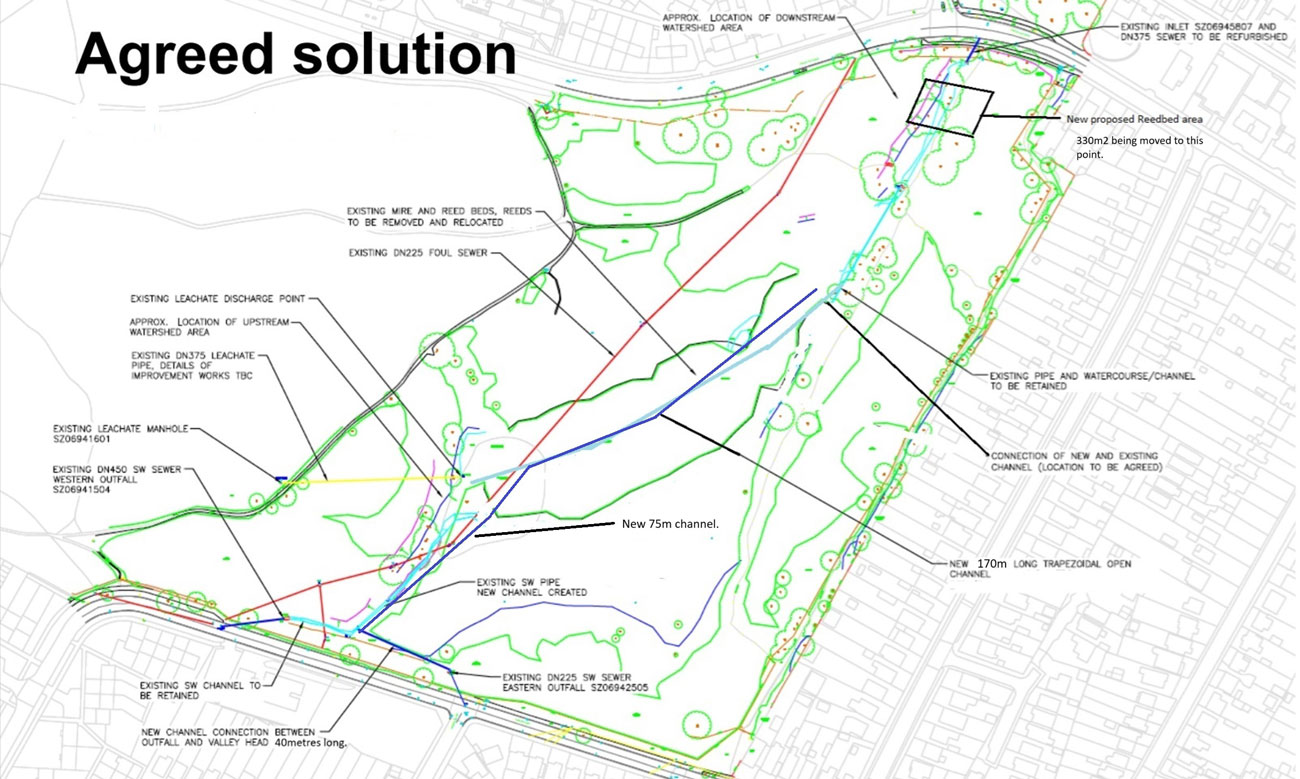
Download the plan as a PDF

Our contractors, FiveRivers, on site at Turbary Common
Background to Turbary Common Valley Mire Restoration
Why was it designated?
Turbary and Kinson Common SSSI is designated under Section 28 of the Wildlife and Countryside Act (1981 as amended). The two heaths are treated as one SSSI, however the rest of this report will only look at the Turbary Common site.
Turbary Common is the largest area of heathland still surviving in north Bournemouth, which overlays the acidic deposits of the Plateau Gravels and Bagshot Beds. The richness of this relic heathland, both in terms of its vegetation and associated fauna, is made even more significant by the urban location. Characteristic of the Bournemouth and Poole areas, the heathland of the higher ground and dry slopes is dominated by heather (Calluna vulgaris) and western gorse (Ulex gallii); also present are bell heather (Erica cinerea) and bristle bent (Agrostis curtisii), the latter especially abundant in areas of frequent burning. On the lower-lying ground there is humid and wet heath which is largely dominated by purple moor-grass (Molinia caerulea) and cross-leaved heath (Erica tetralix), together with varying amounts of heather and deergrass (Trichophorum cespitosum).
The impeded drainage and peat accumulation within the valley bottom of Turbary Common has led to the development of the valley mire systems with the associated bog communities. These areas hold a rich bog flora with frequent oblong- and round-leaved Sundew (Drosera intermedia and D. rotundifolia), bog asphodel (Narthecium ossifragum) and white beak sedge (Rhynchospora alba); also present is the uncommon pale butterwort (Pinguicula lusitanica). Bog mosses, including Sphagnum cuspidatum and S. papillosum, are frequent throughout these areas. Shallow bog pools contain common cottongrass (Eriophorum angustifolium) and bog pondweed (Potamogeton polygonifolius). Drier parts of the bog contain tussocks of purple moor-grass. The fauna of the site reflects the range of habitats present. The dry heathland of Turbary Common supports a breeding population of the rare and protected sand lizard (Lacerta Agilis). A diverse range of dragonfly species are found here and many are known to breed on site. The damper areas harbour large populations of the local bog bush cricket (Metrioptera brachyptera), with the rarer long-winged conehead (Conocephalus discolor) found in slightly drier conditions. There are also recent records of other nationally scarce species at the site. Turbary and Kinson Common SSSI are part of the Dorset Heathlands Ramsar, Dorset Heathlands Special Protection Area (SPA) and Dorset Heaths Special Area of Conservation (SAC).
Mire flora
In the wetter areas of the mire, there is extremely rich and varied bog flora which includes oblong-leaved sundews and round-leaved sundew, bog asphodel, white beak-sedge, pale butter butterwort, early marsh orchid, heath orchid, flea sedge and bog mosses Sphagnum spp. Throughout the drier parts of the mire, the dominant plant species is purple moor grass that has formed large tussocks. Figure 1-3 Mire flora Figure 1-4 Bog pool flora The bog pools contain species such as common cotton-grass and bog pondweed and there are stands of bog myrtle. However, there have been changes seen in the last 20 years to a change in this flora, as common reed now dominates a large part of the wettest areas of the mire where there is also a significant stand of reedmace. The council who own the site have introduced grazing and this has had some notable benefits. For example, bog pools have been opened up and light poaching has created ideal habitat for pale butterwort and sundews. The animals are also grazing the periphery of the reed bed, slowing down its expansion rate.
Mire fauna
The area supports a rich invertebrate fauna. The habitat is particularly attractive to dragonflies and damselflies, two of the more notable species being scarce blue-tailed damselfly and small red damselfly. Bog bush cricket and swamp spider also occur. Until 2004, a small colony of silver studded blue butterflies was present but there have been limited recent sightings. The rich invertebrate fauna of this area attracts common lizards that are found in large numbers in the drier parts of the bog. Adder and grass snake also hunt amongst the Molinia tussocks for small mammals, lizards and amphibians. The permanently wet conditions found in this area attract overwintering snipe with counts of over 100 birds. Occasionally, jack snipe (Lymnocryptes minimus) can be seen with the snipe flock. Woodcock (Scolopax rusticola) are seen most winters along with teal. Other bird species recorded include reed bunting (Emberiza schoeniclus), reed warbler (Acrocephalus scirpaceus), sedge warbler (A. schoenobaenus) and meadow pipit (Anthus pratensis).
Project details
Budget £200,000
Funding Wessex Water
Contractor FiveRivers
Project Leader Tom Bennett, Countryside Area Manager (Central), BCP Council
E. tom.bennett@bcpcouncil.gov.uk